Does ChatGPT know your business?
More and more people skip the search results and ask an AI to recommend someone. It answers with two or three names. How those names get chosen, and what you can do this week so yours is one of them.

Adí Aviram
Small business · · 7 min read

Someone in Lisbon needs a wedding dress taken in, and the wedding is in two weeks. She does not type "tailor Lisbon" into Google and scroll. She opens ChatGPT and writes: "I need a tailor near Alfama who can alter a wedding dress in under two weeks and speaks English." The answer names three shops, with a line about each. She calls the first one. The other forty tailors in the city never had a chance.
That is the whole change in one scene. A search engine shows you ten links and lets you choose. An AI assistant chooses for you, and shows you the shortlist. For a small business, the question is no longer only "am I on the first page of Google?" but also "am I in the answer?"
This is not a future scenario
Yext, a company that manages business listings, surveyed 3,848 adults who search for local businesses for its 2026 consumer search report. 42.7% had used an AI tool to look for a local business in the past month. 28% had tried a new local business in the last six months because an AI recommended it. Yext sells listing management, so it has an interest in the topic, but the direction matches what anyone can see on their own phone: people ask, and they trust the answer more than they used to.
What happens next is the interesting part. Very few people go straight from the AI's answer to buying. They check first.
Half of them open your website. If it is there, clear and current, it confirms what the AI said. If it is slow, vague or out of date, the recommendation dies on your own page. And the businesses that don't need a website still need the other half of the answer: a profile and listings that say the same thing everywhere.
Where the AI gets its answer
An AI assistant does not know your business from experience. When it answers a question like the one in Lisbon, it searches the web, reads what it finds and summarises it. Which web it searches depends on the tool. Google's AI answers draw on Google's own index and on Business Profiles. ChatGPT's search leans mainly on Microsoft Bing's web index, not on Google's, which surprises most business owners.
When BrightLocal ran 800 local searches in ChatGPT and recorded the sources it showed, 58% were business websites, 27% were pages that mentioned a business, such as articles and guides, and 15% were directories. The study is from the US and from late 2024, and these tools change fast, but the pattern is useful: the single biggest source was the businesses' own websites.
So there are three places that decide whether you are in the answer. Your own website. Your listings, on Google, Bing and the directories of your trade. And what other people write about you.
Write down what you would say on the phone
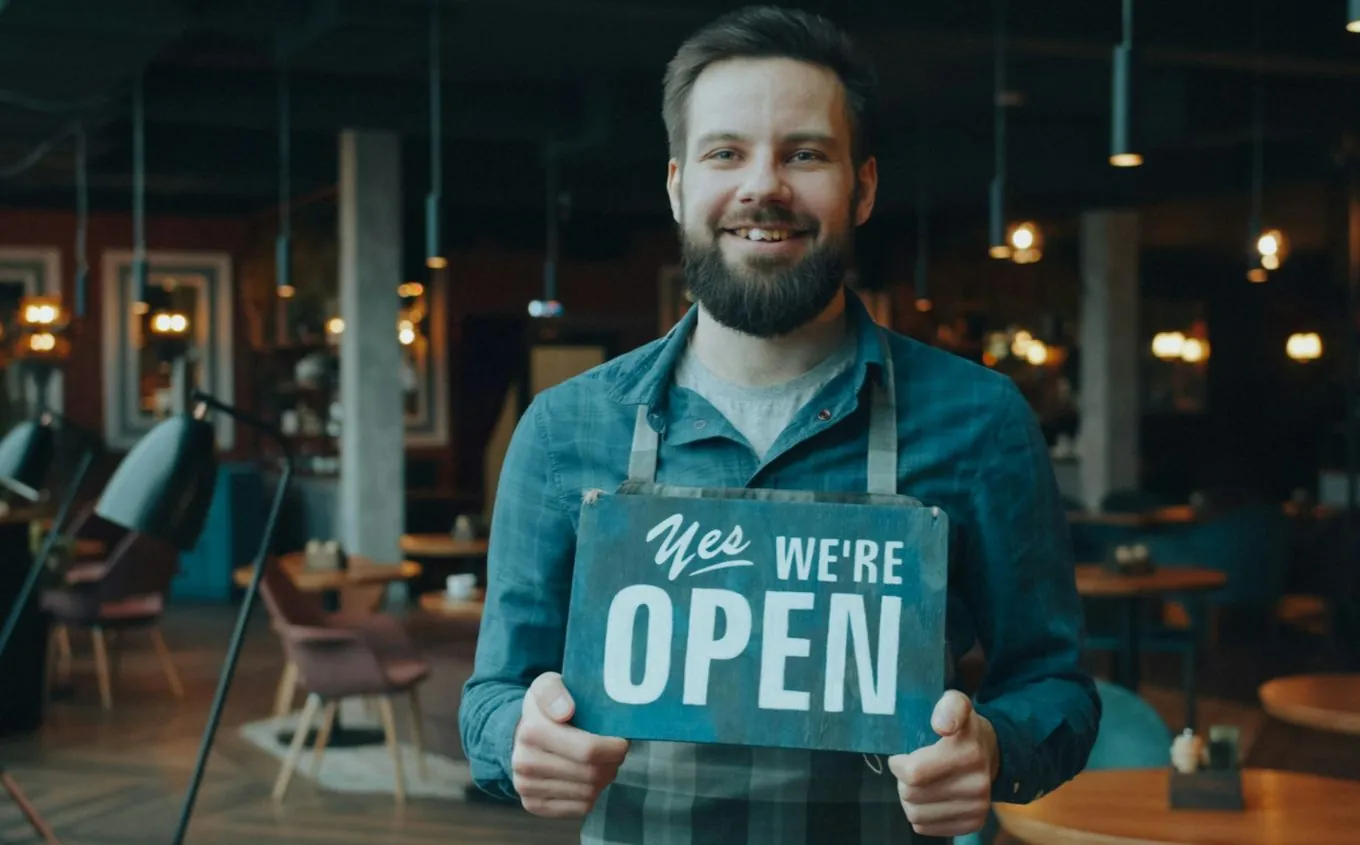
Most small business websites are made for people who already know the business. A beautiful photo, a slogan, "Welcome", a contact button. A person fills in the rest. An AI cannot. It needs the facts in plain text: what you do, for whom, where, at what price level, in which languages, and what makes you different from the shop down the road.
Think of the questions people really ask when they call you, and answer them on the page in normal sentences. "We alter wedding and evening dresses. Most alterations take one to two weeks; for urgent jobs we can do five days. We speak English, Portuguese and Spanish. We are a ten-minute walk from Alfama." Every one of those sentences is something an assistant can quote when someone asks exactly that.

[image] Welcome to Atelier Rosa. [image] Discover our world. Contact.

Atelier Rosa. Alterations and wedding dresses, ten minutes from Alfama. Wedding and evening dresses, usually one to two weeks. Urgent jobs in five days. We speak English, Portuguese and Spanish. Open Tuesday to Saturday, 10 to 19.
Two mock-ups drawn for this post. The shop is invented. Photo: Arawark Chen, Unsplash.
Text inside images counts for nothing here. Neither does information that only exists in a PDF menu, an Instagram story or a slider that loads late. Google itself says it in its guidance on AI features in search: make sure "important content is available in textual form". The same page also says there are "no additional requirements" and no special optimisation needed to appear in its AI answers. That is good news. It is mostly old, sensible advice, finally with a reason everyone can see.
Make your facts agree everywhere
An AI that finds two opening times for your shop, or an old address on one site and a new one on another, either picks one at random or leaves you out. Go through every place your business appears and make the name, address, phone number, opening hours and services match exactly. Start with your Google Business Profile, which feeds Google's AI answers directly. Then claim your listing on Bing Places, which almost nobody does and which takes twenty minutes; Bing's results are a big part of what ChatGPT reads. Then the directories that matter in your field: Tripadvisor for restaurants and rentals, the professional registers for doctors and lawyers, the trade association for craftspeople.
Get mentioned by someone other than yourself
An AI looks for confirmation, just as people do. A shop that only talks about itself is less convincing than one that a local newspaper, a neighbourhood guide or a wedding blog has written about. You cannot fake this, and you should not try. But you can make it more likely: tell the local paper when you do something new, join the association of your trade, ask happy customers for reviews, and answer them. Reviews are read by AI tools as well as by people, and an owner who replies to them looks like a business that is alive.
The technical part, briefly
Three things are worth asking whoever looks after your website.
- Structured data. A small block of code in your pages, in the schema.org vocabulary, that tells machines in a fixed format what kind of business you are, where and when. Google asks that it matches what is visible on the page, so it cannot be used to claim things the page does not say.
- A real questions page. Not marketing dressed up as questions, but the ten things customers actually ask, with direct answers. It is the format AI assistants quote most easily.
- Not blocking the readers by accident. Some websites, and some security plug-ins, block AI crawlers in a file called robots.txt without the owner knowing. OpenAI, for example, uses a crawler called OAI-SearchBot for ChatGPT's search; if it cannot read your site, ChatGPT can only describe you from what others wrote. Whether you allow AI tools to train on your content is a separate choice, and you can say no to training while still allowing search.
None of this works if the page is slow or broken on a phone, because the people who check after the AI's recommendation are on their phones. And if your guests or customers come from abroad, the same text in their own language gives the AI something to quote in that language too.
Test it this afternoon
Open ChatGPT, Gemini and Perplexity and ask them two things. First, about you directly: "What do you know about [your business] in [your city]?" Then the way a customer would ask, without your name: "Recommend a [what you do] in [your area] that [the thing you are good at]." Write down what each one gets wrong, what it leaves out and who it recommends instead of you.
Then fix the sources, not the AI. If it says you close at six and you close at eight, the old time is written somewhere; find it. If it does not know you do weddings, your website probably never says so in a sentence. If it recommends a competitor, look at that competitor's website and listings and you will usually see why within five minutes.
What to be careful about
You will see agencies selling packages that promise to put you "at the top of ChatGPT". Nobody can promise that. The answers change with every question, every user and every update, and there is no way to pay an AI assistant to be written into its answer, just as Google says there is no way to pay for a better local ranking. What you can do is make yourself easy to understand and easy to confirm. That is not a trick, it is a clear website and honest listings, and it is the same work that makes a human visitor trust you. If you want to start on the website part, this is the list to bring to the first conversation.
Sources
- Yext: Consumer Search Behaviors Report 2026, published by a listings company
- BrightLocal: Uncovering ChatGPT search sources (2024)
- Search Engine Land: How does ChatGPT conduct local searches?
- Google Search Central: AI features and your website
AI search tools change quickly. What is true for ChatGPT or Google today may work differently in a few months; the basics in this post will not.
Adí Aviram
Design, illustration and SEO at Frisun. Adí is a creative developer, designer and illustrator. She builds websites that tell a story: scrollytelling, data visualization, interactive maps and illustration. She has worked on projects with +972 Magazine, Göttingen University and the Goethe Institute. Adí brings the colour, the motion and the character to every site you get from Frisun. About the studio